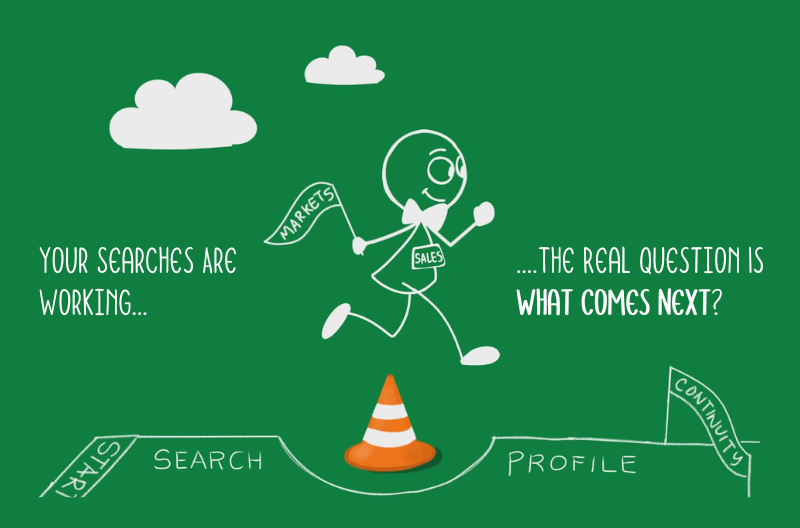
Across MT Connect usage, one pattern is becoming increasingly clear: search is not the bottleneck.
In fact, when we look at market-level queries—such as country-specific searches like Czech, Germany, Greece, Finland, or France —we consistently see strong relevance rates.
This tells us something important: the underlying data and matching logic are performing well.
So the question becomes less about “does it work?” and more about “what happens after it works?”
The real behaviour we’re seeing
Most users follow a familiar path:
- Run a targeted search
- Review relevant sources
- Validate market availability
- Pause
That pause is where things typically stall.
Not because users are dissatisfied, but because the workflow ends at discovery rather than continuing into structure.
Search vs. structured intent
A search is designed to answer a momentary question.
A Search Profile is designed to hold intent over time.
Instead of repeatedly defining the same need, users can structure it once and allow it to operate continuously in the background.
This changes the dynamic in three ways:
- From repeated effort → to maintained intent
- From isolated results → to ongoing relevance
- From manual checking → to structured flow
Why this matters
In media intelligence workflows, repetition is rarely the goal. Continuity is.
When teams rely only on search, they stay in a cycle of re-validation. When they move into structured profiles, they start building operational consistency.
The difference is subtle, but important.
What comes next
The strongest signal from usage today is not a lack of engagement—it’s early-stage exploration of capability.
The next step is simply making intent more persistent.
Because once search is already working, value doesn’t come from searching more.
It comes from searching once—and letting it continue to work.
The next step is simple: create a Search Profile, and let intent carry forward.